
The Weight Has Shifted
On leaving Scottish Labour, and what comes next

I was in primary six when my uncle Ian Davidson made me fall in love with politics. “You’re not messing me about. You’re actually interested in this?” It felt like an initiation, I still recall the Green Paper, a preliminary consultative document was exciting. He meant it as a compliment.
Ian was a Scottish Labour and Cooperative MP for twenty-three years. Glasgow South West, 1992 to 2015. Chair of the Scotland Committee. A Labour man for sixty years. He voted against the Iraq War. For those of us millennials coming of age then, that was his finest moment — the man who, when the party machine demanded loyalty, chose his conscience instead.
He now advises Malcolm Offord’s Reform group at Holyrood. A fresh role he withheld until the election passed, out of respect for old colleagues.
I want to explain why this isn’t a betrayal. And what it means for me.
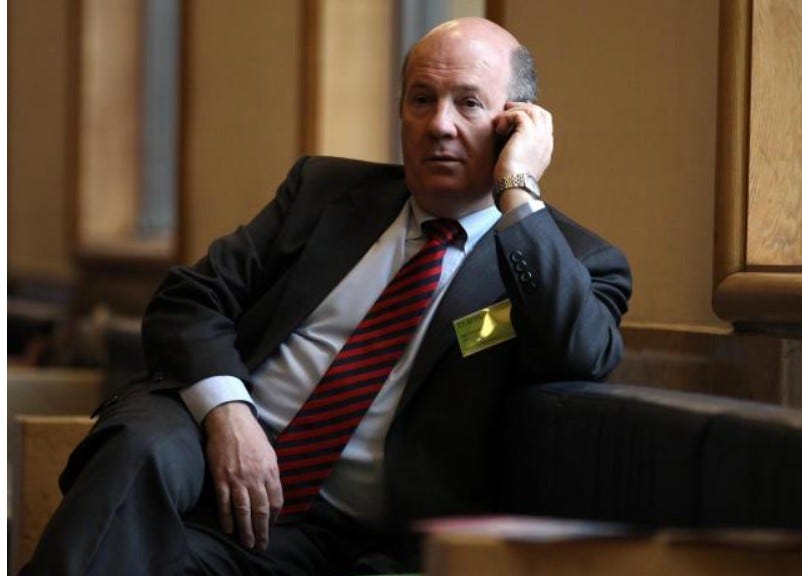
Ian was never comfortable with the liberal consensus. Eurosceptic when that was unforgivable in Labour. Be backed brexit, serving on the board of Vote Leave, the official campaign group in support of Brexit. He long stood on principle, said what he thought, when his party disagreed. What finished him wasn’t ideology. It was devolution. “An enormous disappointment,” he told The Herald last week. “It needs a kick up the backside.”
He is right. And those of us who argued that the federal solution — the kick that could actually transform devolved Scotland into something worth preserving — would come through Labour are now confronted with the evidence.
Keir Starmer holds a 172-seat majority. He could call a constitutional convention. He could create a Senate of the Nations. He could introduce fiscal federalism — real tax-raising powers, not income tax tinkering. He could replace the Lords. He could pass constitutional legislation the upper chamber cannot block. Any of these would represent the kind of shock therapy Scotland and the Union desperately need.
Instead: removing hereditary peers (only elected members, ironically). Giving mayors control over bus franchises. Calling it “devolution of power.”
I argued in Scotland Undone that Labour’s tragedy was possessing the numbers to pursue transformative federal reform while lacking the political will to use them. I had hoped to be wrong. The 2026 Holyrood campaign confirmed the diagnosis. There was no constitutional vision. No federal offer. Nothing that would give Scottish voters a reason to believe the Union was capable of becoming something worth choosing.
The result: Scottish Labour tied with Reform on seats. Behind the Greens on the Glasgow regional list.
I understand the Reform vote better than I am comfortable admitting, and I say this without condescension.
The people who voted Reform in Scotland are not, for the most part, the moral catastrophe the commentariat describes. Many are working-class unionists who watched post-industrial communities hollowed out, watched devolution’s promises evaporate, watched an SNP government substitute identity politics for economic delivery, and concluded that every available establishment vehicle had failed them. They are not wrong about the failure. They are reaching for whatever looks capable of forcing the question.
Scotland Undone treats Reform as a diagnostic signal, not a moral emergency. The anger is legitimate. The vehicle is incoherent — still anchored to English nationalism, still without a credible Scottish constitutional offer. But the underlying demand is real: that someone, somewhere, be held to account for thirty years of managed decline dressed in progressive rhetoric.
Reform voters and Labour leavers are not natural allies. But they are reading the same evidence.
Leaving a political tradition isn’t a decision. It’s sediment. It accumulates until one day you notice the weight has shifted, and you realise the decision was already made.
I had already ceased paying my membership dues. I knew, in the way you know things you don’t yet want to say out loud, that Scottish Labour could no longer be the vessel for what I believe Scotland needs: federal transformation as the precondition for Scottish renewal, not the consolation prize offered after everything else has failed.
Ian followed the logic. I understand it. I’ve chosen a direction — an argument I’ve spent three years making: that Scottish renewal and British federalisation are inseparable, and that the party capable of delivering both has not yet existed or shown itself.
Playing in the background, as I write this, is Aberystwyth — Joseph Parry’s melody set to Charles Wesley’s 1740 words. It seemed appropriate. End one tradition. Embrace another. Both, in their origins, of the working class.
C’est fini. It mattered deeply. But the weight has shifted. And the argument requires somewhere new to be made from.
Scotland Undone: Nationalism, Dogma, and Decline in the Devolution Era is available on Amazon is available here
My work is reader-supported and will always be free to read. If you value it, consider subscribing — free or paid.
Dean M Thomson is currently a lecturer with Beijing Normal - Baptist University (BNBU), formerly known as Beijing Normal - Hong Kong Baptist University, United International College (UIC).
I fully understand your loyalty to your uncle and your indebtedness to him for the role he played in your political upbringing but I find your defence of his decision to advise Lord Offord and Reform unconvincing. I have known Ian over many years and would describe his politics as, for want of a better word, reactionary. Not for him the socially liberal values of the Labour Party. I was delighted when he won Govan back from the SNP but his decision to play a lead role in
the Scottish Brexit campaign was inexplicable.
Of course there are many electors turning to reform who do not share the most extreme views of their leaders - there have always been Labour supporters with reactionary tendencies. But this goes way beyond understanding why voters would support Reform. To advise the odious Lord Offord is nothing short of betrayal. I’m afraid I don’t buy the argument that his driving force is his belief in federalism. It is always disappointing to see someone who has done very well off the back of the Labour Party all his working life turn and stab it in the back.
I don't think Reform are offering federalism or any other firm of Constitution shake up. Reform offer nothing other than unspecified change for the sake of change. This problem has dogged UK politics for decades. Sarwar promised change but was unable to articulate what it might look like. His campaign ultimately was reduced to a cynical ferries and hospitals smear campaign. Federalism would obviously be a better solution than devolution, but it sounds like a halfway house, why not go the whole hog if it is change you so deeply desire??