
The Cause Had a Face
Eight years of Sturgeonism, C.S. Lewis, and the machine that sent flowers

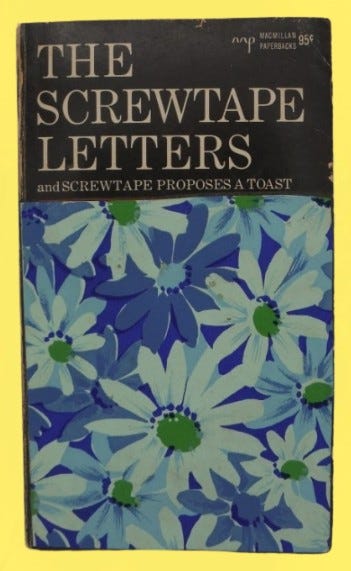
On 13 June 2023, while police investigated the financial affairs of the Scottish National Party, SNP MSPs held a group meeting. The meeting was, by the account of deputy leader Keith Brown, “very constructive.” There was, he reported, “huge support” for the current leadership — and a decision had been taken to send flowers to former First Minister Nicola Sturgeon, who had been arrested and released earlier that week, as a mark of sympathy for what she had been through.
The flowers. Consider them for a moment.
Sturgeon had been arrested — the third senior SNP figure to be so — as police continued investigating the party’s finances. Her husband, Peter Murrell, who had been the party’s chief executive for over twenty years, was already facing scrutiny over missing independence referendum funds, and what would turn out to be the embezzlement of hundreds of thousands of pounds in party funds. The machine she had built under the aegis of her presidential personality leadership was encircling the house she had shared with the man who had been stealing from the party she led. And the machine sent flowers.
C.S. Lewis would not have been surprised.
The Screwtape Letters (1942) is a satirical novel presented as correspondence from a senior demon, Screwtape, to his inept nephew Wormwood, advising on how to corrupt a human soul. What makes it endure is not the theology but the sociology: Lewis’s vision of hell as a bureaucratic hierarchy where power is hoarded, loyalty is performed, and the strong eventually consume the weak. Every act of affection conceals appetite. Every expression of solidarity is a survival calculation. In hell’s final accounting, you either bring back food or you become it.
I wrote last year about the applicability of this framework to Donald Trump’s inner circle — the Bannons, Giulianis, and Cohens consumed in turn, loyalty rewarded with betrayal, flattery the only available currency. The parallel worked well enough. But the SNP finances scandal is not merely a story about power consuming itself. It is a story about how a particular style of political governance — personalised, control-obsessed, and wrapped in the language of a moral cause — created the precise conditions in which sustained financial fraud became possible, went undetected, and was actively shielded from scrutiny. It is, in short, an anatomy of the Sturgeon era. And Lewis’s hell, which is most dangerous not when it operates through cynicism but when it operates through the language of virtue, maps onto that era with uncomfortable precision.
That distinction — between Trumplandia’s open cynicism and the SNP’s moral architecture under Sturgeonism — is everything.
The Cause as Screwtape
“Any small coterie, bound together by some interest which other men dislike or ignore, tends to develop inside itself a hothouse mutual admiration, and towards the outer world, a great deal of pride and hatred which is entertained without shame because the 'Cause' is its sponsor and it is thought to be impersonal”
In one of his early letters, Screwtape explains the particular value of causes and coteries. Any small group bound by a shared interest tends to develop mutual admiration internally and, towards the outside world, a righteous contempt requiring no justification because the Cause is its sponsor. The members experience the pride not as pride but as principle. The hostility not as hostility but as moral clarity. And crucially — the Cause is thought to be impersonal. It is bigger than any individual. It cannot be questioned without betraying something larger than yourself.
The Scottish independence movement provided exactly this architecture. But under Sturgeon’s leadership something more specific happened: the cause and the leader became, in the political imagination of the movement, the same thing. Sturgeon did not merely lead the SNP. She was the SNP, and the SNP was independence, and independence was Scotland. To question her governance was not just disloyal — it was somehow anti-Scottish. The impersonality Lewis describes as the Cause’s greatest asset became, in practice, intensely personal.
This matters for what followed. Sturgeon has spoken openly about her imposter syndrome — the private anxiety behind the public authority. What Lewis understood is that this combination is not a contradiction but a mechanism: the surface confidence requires the tight grip, the micromanagement, the control of information, the party run — as Cherry put it — with a rod of iron, hand and glove with her husband. The Covid inquiry revealed a government in which officials were advised to delete messages as a pre-bed ritual and in which a senior civil servant boasted that plausible deniability were his middle names. The apparatus of the Scottish state had been made, in one journalist’s phrase, a facilitator of nationalism rather than of good government.
This is the Screwtapian coterie made institutional. And its effect on financial accountability was exactly what Lewis would have predicted: scrutiny became betrayal. To ask where the ring-fenced independence referendum fund had gone was to be, in the party's internal grammar, a wrecker, a unionist, a grievance-merchant. Joanna Cherry KC described what happened when she pressed for financial transparency: she was, in her own words, demonised for asking the questions. Douglas Chapman resigned as National Treasurer after being denied the financial information needed to perform his statutory duties. Three members of the Finance and Audit Committee resigned simultaneously, unable to access the party's books. Under Sturgeon, that mechanism ran so deep that the movement's own elected scrutineers — Cherry, Chapman, the audit committee members — were expelled for trying to do their jobs. The independence movement was as much a victim of this arrangement as anyone. The Cause had a face. And the face could not be questioned.
Jargon, Not Argument
“Jargon, not argument, is your best ally.”
Screwtape’s first and most fundamental instruction is this: never allow the patient to ask whether something is true. The goal is not to win arguments but to prevent argument from arising at all. The instrument is jargon — words that perform clarity while producing confusion, that appear to answer questions while evacuating them of content.
Over twelve years, the SNP developed a remarkably consistent grammar of evasion on the subject of its finances.
The independence referendum fund, raised from party members on the explicit promise that it was frozen and protected for a future vote, was described by the National Treasurer in October 2020 as having a specific balance and being ready for instant deployment. By June 2021, the same fund was “woven through” the overall income figures — a description that is, linguistically, the precise opposite of frozen. When Sturgeon was pressed on the party’s accounts, she told the public they were managed on a cash flow basis. The SNP’s own accounting policies stated they used accrual accounting. These are not interchangeable terms. The distinction matters. Sturgeon either did not know the difference or chose not to clarify it.
Then, the day after Murrell pleaded guilty to embezzling more than £400,000, First Minister John Swinney offered the following: the ring-fenced fund had simply been part of the resources available to a party of independence, deployed for independence. If that was not what the resources were for, he was not sure what they were for.
This is Screwtape’s jargon at its most refined. Read charitably, it is a defence. Read carefully, it abandons twelve years of official party assurances in a single sentence, while being constructed to sound like common sense. Swinney did not explicitly say the donations had always been general funds. He simply reframed the question in language that made the specific promise given to donors feel somehow beside the point. It is worth noting that no one in the Scottish media appeared to observe that Swinney had just answered the question everyone spent four years pretending was unanswerable.
The Gentle Slope
“The safest road to Hell is the gradual one.”
Lewis observed that the safest road to perdition is the gradual one — no sudden turnings, no milestones, no dramatic moments of choice. The corruption arrives through accumulation.
Peter Murrell did not steal £400,000 in a single audacious act. He stole a parking ticket. He stole an egg poacher, logged as general equipment. He stole 383 Amazon deliveries — mostly to his home address, totalling over £42,000 — filed under miscellaneous expenses. He charged the party for two luxury watches entered as event merchandise. A robotic lawnmower for his Glasgow home appeared under legal fees. Ethernet cabling that was in fact a luxury kitchen item. Salt and pepper grinders costing £2,618. Over twelve years, by false receipts and misleading accounting codes and the considerable advantage of being the only person who approved his own expense claims, the SNP’s chief executive stole from the party his wife led.
The mundane specificity of that ledger is not incidental. It is the argument. Lewis understood that damnation does not require a dramatic villain. It only requires that each small step feel just reasonable enough to take, until looking back is no longer possible and looking forward has lost its point.
What the ledger also reveals is an institutional environment in which the gentle slope was structural. A chief executive who approved his own expenses without receipts. An auditor who signed off the accounts, then the following year introduced language about fraud risk that had never appeared before, then resigned. An NEC whose own elected officers were refused sight of the books they were legally responsible for scrutinising. The slope was not Murrell’s creation alone. It was maintained collectively — by enough people deciding, independently, that not looking was more comfortable than looking.
The Cast
“Bring us back food, or be food yourself.”
Lewis’s letters end with Screwtape preparing to consume Wormwood entirely, signing off with affection that was always appetite. “Your increasingly and ravenously affectionate uncle” is the final register — the warmth of the senior figure towards the junior made suddenly visible as predation.
The flowers from Keith Brown arrive in precisely this register.
Murrell is Wormwood: sent to do the party’s operational work, given access he should never have had, consumed when the arrangement became untenable. The donors are Lewis’s patients — not cynics but believers, people who gave their money for Scotland’s future and received, in return, a robotic lawnmower and a motorhome. Cherry and Chapman are the Enemy’s agents in Lewis’s schema: the figures whose insistence on doing what their roles required made them, in the hierarchy’s eyes, the most dangerous people in the room.
Swinney is the lesser demon who has learned the rules so thoroughly he no longer notices he is following them. His May 2021 statement — that he did not understand why the National Treasurer had resigned after publicly stating he was being denied the financial information needed to perform his legal duties — is not the incomprehension of a man facing the unknown. It is the incomprehension of a man who has trained himself, over many years, to look in a particular direction.
And Sturgeon? Not victim, but architect. She built the governance culture. She told the public the accounts were independently and fully audited while the auditors were privately flagging fraud risk and preparing to resign. She warned the NEC to be careful about raising financial questions because the party depended on donors. Her BBC interview in the days after the guilty plea — composed, assured, elegantly redirecting every governance question into a defence against criminal charges nobody was actually making — was the Screwtape move in its most polished form: the senior figure performing wounded dignity while declining to acknowledge the question actually being asked.
Lewis wrote that a spoiled saint makes better sport in hell than a common tyrant. Screwtape is not a criminal. He is an architect. The SNP presented itself as the moral conscience of Scottish politics for a generation — and that pretension is precisely what made the architecture load-bearing. The corruption did not happen despite the cause. It happened inside it, sustained by it, protected by it. The cause, as eight years of Sturgeonism revealed, was never about independence at all — but about herself. Every ordinary member who canvassed, donated, and believed was, in Lewis's terms, the patient. The machine they built their hopes around was sending flowers.
The Flowers, Revisited
“Your increasingly and ravenously affectionate uncle.”
Screwtape’s hell is not frightening because it is dramatic. It is frightening because it is recognisable — bureaucratic, self-justifying, warm in its expressions and cold in its calculations, convinced of its own righteousness until the final accounting arrives.
On 26 May 2026, Peter Murrell stood in the High Court in Edinburgh and pleaded guilty to embezzling £400,310.65 from the Scottish National Party. The following day, the SNP announced a fresh push for Scottish independence. The ring-fenced fund, raised from members who had been told their donations were protected, was not mentioned.
Keith Brown sent flowers in June 2023. He meant them, I think, as a mark of sympathy.
In Lewis’s telling, that is exactly what makes them so Screwtapian.
My new book ‘Scotland Undone: Nationalism, Dogma, and Decline in the Devolution Era’ is available on Amazon is available here
My work is reader-supported and will always be free to read. If you value it, consider subscribing — free or paid.
Dean M Thomson is currently a lecturer with Beijing Normal - Baptist University (BNBU), formerly known as Beijing Normal - Hong Kong Baptist University, United International College (UIC).
Excellent!
I note this is your fourth article on this topic Dean? I realise that Sturgeon has been union enemy number one for the last 10 years.. but this is becoming tabloidian in it's repitition. You must be confounded though to learn that there has been little if any impact on the independence movement or even the popularity of the SNP.