
From 'Ringfenced' to 'Resources': The Admission John Swinney Didn't Realise He Was Making
A timeline of shifting explanations for the SNP's missing indyref2 fund ended the day after a guilty plea — when the First Minister finally admitted what the money was really for all along.

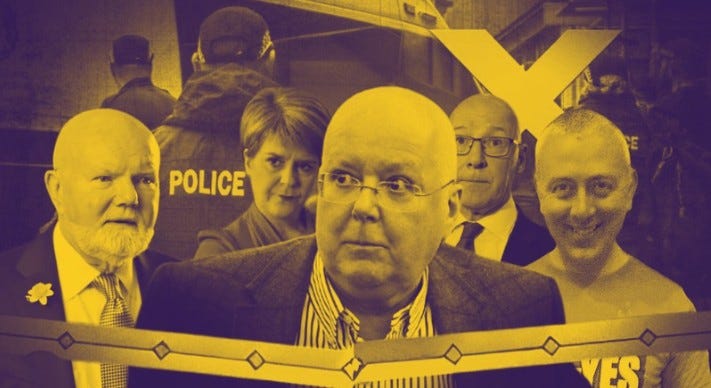
On 3 June 2026, the day after Peter Murrell pleaded guilty to embezzling more than £400,000 from the Scottish National Party, First Minister John Swinney was asked about the ring-fenced indyref2 fund. His answer was revealing in ways he almost certainly did not intend.
“That money,” Swinney said, “was part of the resources available within the SNP to support its independence objectives. If that’s not the use of the resources, then I’m not sure what the resources are for.” He added: “The SNP is a party of independence that uses the resources for independence.”
Read charitably, this is a defence. Read carefully, it is a confession. Because what Swinney has just described — money raised for independence, used for independence — is precisely the framing that the SNP’s own officers spent years explicitly and categorically rejecting. The ring-fenced fund, in the official SNP account between 2017 and 2021, was not general independence resources. It was a specific, protected - “ringfenced” sum reserved for one specific purpose: a future independence referendum. The distinction was not incidental. It was the entire basis on which donors gave their money.
What donors were told
On 13 March 2017, the same day Nicola Sturgeon announced her intention to pursue a second independence referendum, the SNP launched the ref.scot fundraising website. The appeal featured a video from Sturgeon herself and raised £200,000 in its first 24 hours. By the time the website was taken down in June 2017 — abruptly, in the immediate aftermath of the SNP’s dismal general election result — it had raised approximately £482,000. The site carried Murrell’s name in the small print: “Promoted by Peter Murrell on behalf of the Scottish National Party.”
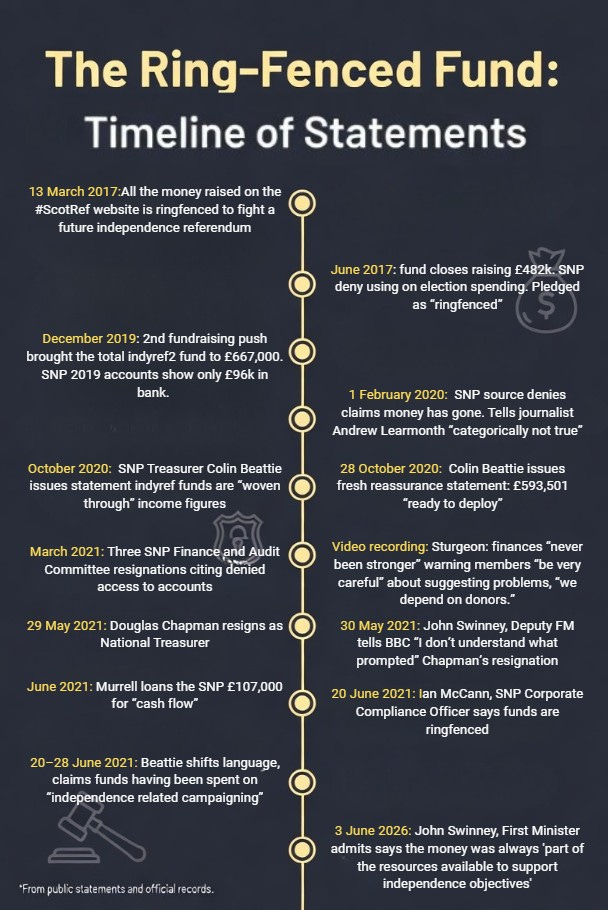
The SNP’s public position on what that money was for could not have been clearer. Its own closing statement on the 2017 appeal read: “All the money raised on the #ScotRef website is ringfenced to fight a future independence referendum.” When Scottish Labour’s James Kelly MSP alleged the funds had been used for election campaigning, the SNP denied it furiously, restating that the money was ring-fenced specifically for any future referendum campaign. A second fundraiser in December 2019 brought the total raised to approximately £667,000. The promise remained the same: this money was not for party business, not for elections, not for general independence campaigning. It was for the referendum.
These were not vague assurances. They were explicit, repeated commitments made to donors who gave money on a specific prospectus. That matters for what follows.
The official story holds
When the SNP’s 2019 accounts were published, they showed the party held just £96,854 in cash and total net assets of approximately £272,000. Questions arose immediately: if nearly £700,000 had been ring-fenced, where was it in the accounts? The then-National Treasurer Colin Beattie issued a statement that raised more questions than it answered, claiming the funds were “woven through” the overall income figures — a description that sat uneasily with the word “frozen.”
But Beattie was not yet ready to concede the fund had been spent. On 28 October 2020 he issued a more specific reassurance. The Referendum Appeal Fund, he said, had a current balance of £593,501. It “remains earmarked for the referendum and are ready to be fully deployed at a moment’s notice.” This was precise. A named sum, a named purpose, and a claim of instant deployability.
In June 2021, the SNP’s Corporate Compliance Officer Ian McCann stated publicly: “Donations are in a ring-fenced fund to fight the next referendum whenever we are in a position to call that.” McCann was not a party spokesman giving a line to a journalist. He was the officer whose function was ensuring the party operated within its own rules and the requirements of electoral law. His statement had a specific institutional weight.
And as recently as February 2020, an SNP source had told journalist Andrew Learmonth that claims the money had been spent on fighting general elections were “utter nonsense” and “categorically not true.”
Taken together, these statements constitute an official record stretching across four years. Multiple officers, multiple occasions, one consistent position: the fund existed, it was protected, and it was reserved for the referendum alone.
The people who couldn’t get in the room
What makes that official record so difficult to accept at face value is what was happening inside the SNP at exactly the same time the assurances were being issued.
In March 2021, three members of the SNP’s Finance and Audit Committee resigned after being refused sight of the party’s accounts. Their names were Frank Ross, Allison Graham and Cynthia Guthrie. They did not resign over a policy dispute. They resigned because they could not do their jobs. At the subsequent NEC meeting, Sturgeon was recorded insisting the party’s finances had “never been stronger” and warning members to “be very careful” about suggesting otherwise, because “we depend on donors.” The footage later became public. At the time, the resignations were.
Then, on 29 May 2021, Douglas Chapman resigned as National Treasurer. His statement was legally precise: “Despite having a resounding mandate from members to introduce more transparency into party finances, I have not received the support or financial information to carry out the fiduciary duties of National Treasurer. I regretfully have resigned with immediate effect.” The Political Parties, Elections and Referendums Act 2000 places specific statutory obligations on a party’s national treasurer. Chapman was stating that he had been prevented from meeting them. This was not ambiguous. It was, in the plainest available language, an allegation of obstruction.
Days later, SNP MP Joanna Cherry resigned from the NEC, also citing transparency concerns. As Ian Murray observed at the time: “Losing three members of your Finance Committee, your Treasurer and a member of your National Executive probably indicates a party in crisis.”
The next day — 30 May 2021 — John Swinney appeared on BBC Scotland’s Sunday Show. He was asked why Douglas Chapman had resigned. His answer: “I don’t understand what has prompted this.” Asked whether police were investigating the £600,000 fund, he replied: “Not to my knowledge, no.” He pointed to the NEC’s scrutiny role and to external audit as reassurances. Neither addressed Chapman’s specific complaint, which concerned internal access to the accounts — not the quality of external oversight.
Swinney’s claimed incomprehension was, on its face, implausible. Chapman’s resignation statement had explained itself in plain terms. The Finance and Audit Committee walkout two months earlier had been publicly reported. The ongoing public controversy over the ring-fenced fund was impossible to miss for anyone engaged in Scottish politics, let alone its Deputy First Minister. To say he did not understand what had prompted the resignation of a treasurer who had just stated he was being denied the financial information required to carry out his legal duties is not a defensible position. It is, at best, a studied evasion.
What the 2026 statement actually means
The record forces a choice between two positions that cannot both be true.
The first is that the fund was genuinely ring-fenced for a future referendum, exactly as the SNP’s own officers repeatedly stated. That is what the anonymous SNP source told Andrew Learmonth in February 2020 — the claims it had been spent on elections were “utter nonsense” and “categorically not true.” It is what Colin Beattie told party members in October 2020, when he named a specific balance of £593,501 and described it as ready for deployment at a moment’s notice. It is what the SNP’s own Corporate Compliance Officer Ian McCann said in June 2021, when he confirmed the money was ring-fenced to fight the referendum “whenever we are in a position to call that.” And it is what the original 2017 public prospectus promised everyone who donated. If this account is true, then Swinney’s June 2026 framing — the money was simply independence resources available to a party of independence — is a post-hoc mischaracterisation, offered in the immediate aftermath of a guilty plea, designed to make a decade of financial opacity sound like routine party practice.
The second position is that the fund was always treated as general independence resources, absorbed into the party’s broader finances and deployed at the leadership’s discretion — which is, on a fair reading, what Swinney now describes. If this account is true, then every officer who told donors, journalists and the Electoral Commission otherwise was not telling the truth. The ring-fencing commitment was not a promise that was broken at some identifiable point. It was a fiction, maintained across at least four years and multiple spokespeople, for the purpose of continued fundraising from supporters who believed their money was protected.
These are the only two options available. There is no third reading of the record in which both the official assurances and Swinney’s retrospective framing can be simultaneously honest.
It is also worth noting what Swinney’s framing does to the obstructions described by Chapman and the Finance and Audit Committee. If the accounts contained nothing more sensitive than general independence resources routinely deployed for independence purposes, what exactly required protecting from the scrutiny of the party’s own finance committee? What was in those books that the National Treasurer — a statutory officer with legal obligations — could not be permitted to see? Swinney’s 2026 explanation does not make the 2021 obstruction more understandable. It makes it less so.
The gap that remains
The guilty plea does not resolve the choice between those two positions so much as weight it. Peter Murrell has admitted to embezzling more than £400,000. The ring-fenced fund raised approximately £667,000. The arithmetic is straightforward and the gap is substantial: even accounting entirely for Murrell’s personal theft, more than £250,000 of what donors were told was protected referendum money remains unaccounted for in any public reckoning. Swinney’s formulation does not close that gap. It reframes it — the remainder was independence resources, used for independence — in language that sounds reasonable precisely because it refuses to engage with what donors were actually promised. The question was never whether the SNP spent money on independence-related activity. The question was whether money solicited for a specific purpose was used for that purpose. John Swinney has now answered that question, without appearing to realise he has done so.
The direct victims of this story are the people who donated their own money to a specific cause on the basis of explicit assurances — assurances that were either always false, or became false at some point that nobody in authority has yet identified. John Swinney has now told us, in effect, that those assurances were not really what they appeared to be. Whether he understands that this is what he has said is another matter.
In May 2021, he told the BBC he did not understand why a treasurer denied access to the party accounts had resigned. Five years on, he tells us the accounts contained nothing more than general independence resources available to a party of independence.
He cannot have it both ways.
My new book ‘Scotland Undone: Nationalism, Dogma, and Decline in the Devolution Era’ is available on Amazon is available here
My work is reader-supported and will always be free to read. If you value it, consider subscribing — free or paid.
Dean M Thomson is currently a lecturer with Beijing Normal - Baptist University (BNBU), formerly known as Beijing Normal - Hong Kong Baptist University, United International College (UIC).
You are so on it Dean. This surely must merit an independent investigation.
A good post, Dean, but misses a key timeline issue. The Rev. Stuart Campbell of Wings over Scotland game identified in the 2018 accounts that there was only (from memory) £67,000 held in cash. The £667,000 indy fund had already evaporated whereas Murrell's embezzling didn't start racking up significant sums until 2019.