
Where I’ve Been

Regular readers will have noticed the gaps have grown longer than usual. No SNP finances update, no fresh federalism argument, no new instalment on the wellbeing economy. I owe you an explanation, and it’s a good one: I’ve been heads-down on a PhD proposal, and it’s been eating every spare hour I have.
For twelve years now, East Asia has quietly done something to me that Britain, for all my love of debating its politics, never quite managed. It captured me, from the day I first came out here in 2014, aged 25, the year I finally came out as gay. And the longer I’ve lived here, the more a particular question has refused to cease pestering me: how does a country like Thailand — never formally colonised, but never left alone by Western powers — actually work through its own ideas about gender and sexuality, when the intellectual tools the ‘progressive left’ reach for to talk about these things were built in nineteenth-century Europe?
That’s not a rhetorical question I’m asking for effect. It’s the actual spine of the research I’m proposing. The standard account — Foucault’s account, the one nearly all serious ‘progressive’ identity politics writing on sexuality still leans on whether it admits it or not — says that discourse *produces* the categories it claims to describe. There was no “homosexual” as a kind of person before nineteenth-century medicine and law invented one. Categories don’t precede the talk about them; the talk makes the categories.
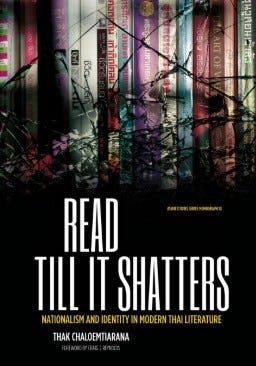
Thailand makes an unusually sharp test case for that idea, because it doesn’t fit. Long before any Western sexology arrived, Thai Buddhism already had its own working categories for gender and sexual difference — built into doctrine, not imported from anywhere. So when Western-style literary forms did start arriving — first the vernacular novel in the 1900s, more recently the Boys’ Love television industry that’s now a genuine regional export — they weren’t writing sexuality into existence from nothing. They were negotiating with something that was already there. That’s a different, and I think more interesting, story than the one usually told, and testing it properly means going back through a century of Thai literary and media history to see the negotiation actually happening on the page and on the screen.
I won’t pretend this is a small detour. It’s a five-year, part-time commitment, on top of the day job, and I’ve started learning to read and write Thai from scratch to do it properly rather than at arm’s length through translation alone. But I think it matters in the same way the Scottish material has always mattered to me: not as academic throat-clearing, but because getting the actual mechanics of how a society argues with itself about difficult things right — rather than assuming the first framework that comes to hand — is worth doing carefully, wherever it happens.
Normal service will resume. The SNP saga isn’t going anywhere, unfortunately. But if a Thai novel from 1925 turns up here occasionally over the next few years, you’ll know why. In the meantime, forgive me for mixing my intellectual, cultural, and academic passions.